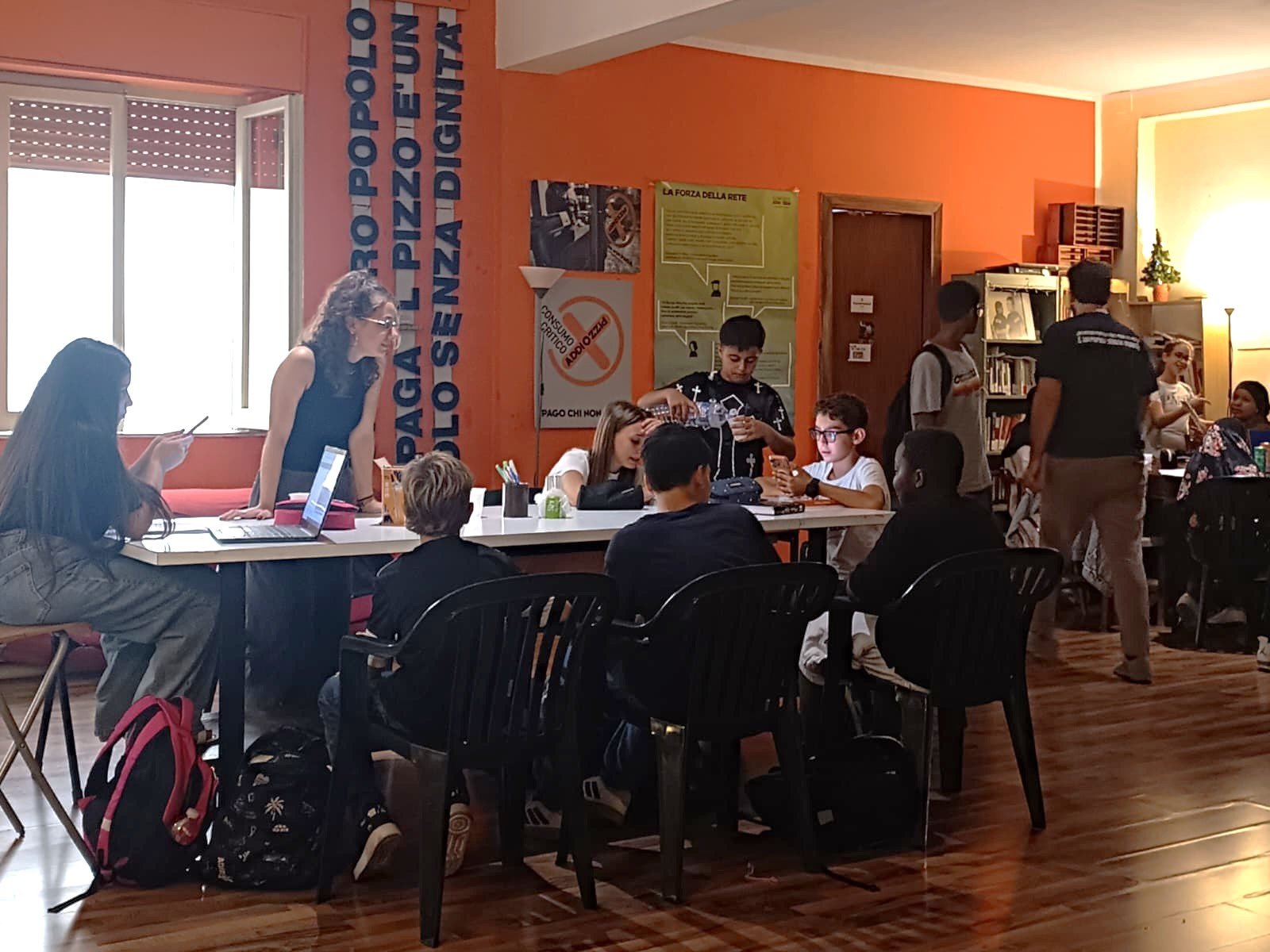
This week, after the summer break, Addiopizzo resumed the free school support it provides to girls and boys from the Kalsa neighbourhood. Sessions are held on Monday and Wednesday afternoons in the confiscated building in via Lincoln that houses the Association’s headquarters, which, as well as being a place of listening and support for shopkeepers and business owners who are victims of extortion, has over the years become an educational hub for young people in Palermo’s historic centre living in conditions of social marginalisation and economic and educational poverty.
The service grew out of a request from the families Addiopizzo works with in the Kalsa through a range of social inclusion activities, who had long pointed to the need for structured school support.
The weeks leading up to the restart were spent getting back in touch with families and schools and gathering the many new requests received in the meantime. For those who have started attending over the last two years, the after-school programme has become a steady point of reference: even those who have moved up to a higher level of education, or have become fairly independent in their studies thanks in part to the work done together, have in many cases chosen to come back, and often not alone. With them have come brothers, sisters, cousins, classmates and, in some cases, even nephews and nieces.
Today the group has more than thirty students, with an almost equal number of girls and boys, attending from the first year of lower secondary school up to upper secondary school, both academic high schools and vocational institutes. Some of them have Bangladeshi, Moroccan and Tunisian origins, and with these students the work often focuses on learning Italian, which is essential both to follow lessons and to move confidently outside the classroom.
These afternoons also become a moment of dialogue in which to face together the difficulties and challenges that the new school year brings.
Early school leaving, including its implicit form, that of students who reach the end of their schooling without the necessary skills, is among the most widely documented risk factors in the paths that lead towards widespread illegality and organised crime, because it reduces the tools young people have to find their way and their access to legal employment, and leaves them more exposed to those who offer alternative routes that often seem the only ones actually available.
Putting study at the centre, stimulating young people’s interest and making the most of each one’s abilities is how we try to offer them an alternative. Supporting shopkeepers and business owners who decide to report extortion is not enough unless, at the same time, we take responsibility for removing the conditions of poverty and exclusion that fuel these phenomena.
We are starting again with many new ideas and the desire to reach, together with the young people and their families, goals that go beyond school results and contribute to the growth of the neighbourhood as a community.
View this post on Instagram