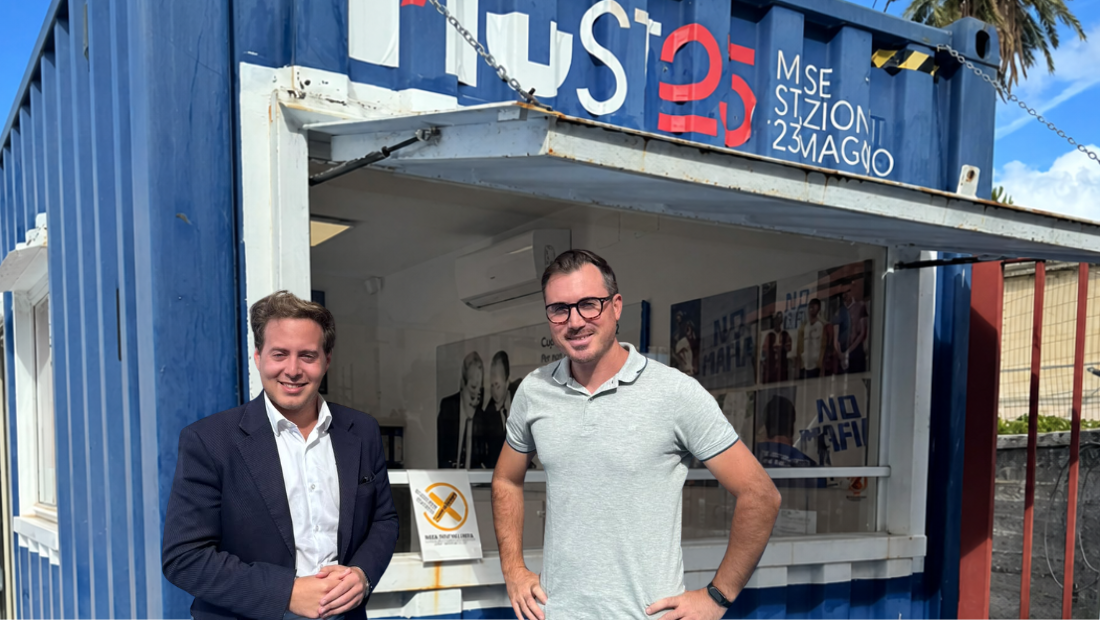
In the former freight yard of Capaci railway station, a short distance from the stretch of motorway where Giovanni Falcone, Francesca Morvillo and three officers of their police escort were killed on 23 May 1992, a group of shipping containers houses MuST23 – Museo Stazione 23 Maggio. Not a “museum about the mafia”, as its founders are keen to point out, but a living memory of the massacre, which starting from that day tells the story of more than thirty years of struggles, commitment, failures and successes in the fight against Cosa Nostra.
The museum was born two and a half years ago from an idea of Addiopizzo Travel, the cooperative that organises responsible anti-mafia tourism itineraries relying on accommodation and services from Addiopizzo’s “Pago chi non paga” network. “We were already telling these stories to our groups on the hill above Capaci,” explains Dario Riccobono, head of MuST23. “We found a space to do it better, in a more powerful way, using technology.”
The space belongs to RFI – Rete Ferroviaria Italiana, which has granted it on a free loan to the association Capaci No Mafia ETS and to the social cooperative Addiopizzo Travel. The museum opened on 22 May 2024, on the eve of the thirty-second anniversary of the massacre: in the yard, next to the tracks where trains still run, the brightly coloured containers have become immersive rooms.
Here visitors can choose between two alternative routes. The first, “Falcone and the Capaci Massacre”, retraces the judge’s life and work through archive footage from Rai and a photo exhibition by Ansa; then, wearing a virtual reality headset, visitors are taken onto the torn-up motorway in the moments immediately after the explosion, among the twisted metal of the cars and the voices of survivors and first witnesses. The second immersive route, “Inside the Maxi Trial”, opened this year, leads instead into the bunker courtroom, reconstructed in virtual reality, where visitors do not simply watch but interact with objects in the courtroom to open documents and listen to testimony from the hearings, including their tragicomic moments. The experience is completed by a documentary produced by Rai Sicilia and TGR Rai for the museum, and by “Interroga il Maxi” (“Question the Maxi Trial”), which makes more than sixteen thousand pages of court records searchable with the help of artificial intelligence.
The museum guides are citizens of Capaci: as well as reconstructing how an attack that still has many unresolved aspects was prepared, they tell from the inside the story of how a community reacted to the massacre by choosing to shout NO MAFIA. Those words can still be read today in huge letters on the small house on the hillside from which the detonator was triggered, clearly visible from that stretch of road.
In the mornings the museum mostly welcomes schools, with a peak in spring, while on Friday afternoons and Saturdays it is more often filled with tourists and visitors. Anyone passing through, with or without a ticket, can stop at the red Feltrinelli container, the first bookshop Capaci has ever had.
The museum, however, is only the starting point of a grassroots urban regeneration project, built with and for the community. The outdoor yard, recently renovated, has been named Piazza Connection, a nod both to the Pizza Connection investigation that made Falcone known throughout the world and to the idea of a place made of encounters. The flowerbeds are filled with plants donated to the museum by local residents, each dedicated to a loved one, an event or a message chosen by the person who brought it. Between a giant chessboard and a hopscotch grid painted on the ground for children, there is also a corner with wooden benches for relaxing or reading.
“In Capaci there is no cinema, no theatre, no parish youth centre, no place where young people can get together,” says Dario. “That’s why, after the programme of events we put together last summer with local associations, the idea is for the square to become an open-air cinema, an outdoor theatre, a place where people can meet.” Next to the square stands the former passenger building, also granted on free loan. Once restored, which will require substantial resources, it will become the house of associations, a shared space where local organisations can come together and host events and performances all year round.
Behind the project are those who were the young people of Capaci in 1992 and who have never stopped working on the memory of those days since. It is no coincidence that the museum was born in a station, a place where you arrive and from which you set off again: the idea is that Capaci, for many still just the name of a massacre, should become the destination of a “secular pilgrimage”, a form of ethical and sustainable tourism that brings visitors into contact with the local community and from which they leave with a different view of this land.